English Grammar Quiz for Beginners – Level 3 | 60 Questions
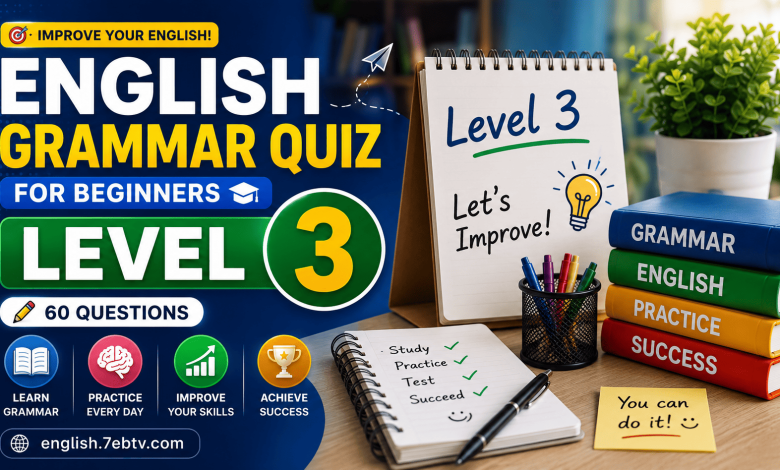
Welcome to Level 3
Welcome to the third level of our English grammar series. In this lesson, you will learn useful grammar structures that will help you understand and build more natural English sentences.
Study each topic carefully, review the examples, and then test your knowledge with the 60-question grammar quiz at the end of the lesson.
Essential English Grammar for Beginners
This lesson introduces important grammar structures that will help you build clearer sentences, talk about different times, describe future plans, give advice, and express conditions in everyday English.
Present Continuous
The present continuous is used for actions that are happening now or around the current time.
Subject + am / is / are + verb-ing
I am reading a book.
She is cooking dinner.
He is talking on the phone.
We are studying English.
They are playing football.
✗ She is cook dinner.
✓ She is cooking dinner.
Words such as now, right now, at the moment, and today often appear with the present continuous.
Present Simple vs. Present Continuous
These two tenses can both describe actions in the present, but they are used for different situations.
Use it for habits, routines, and facts.
I work every day.
She drinks coffee every morning.
Water boils at 100°C.
Use it for actions happening now or around now.
I am working now.
She is drinking coffee.
They are studying today.
I play tennis every Saturday.
I am playing tennis now.
Past Simple: Questions & Negatives
Use the past simple to talk about completed actions in the past. Use did to form questions and didn’t to form negative sentences.
Did + subject + base verb?
Did she visit London?
Did they play football?
Subject + did not / didn’t + base verb
She didn’t go to school.
They didn’t buy anything.
After did or didn’t, use the base form of the verb.
✓ Did she go?
✗ Did she went?
Past Continuous
The past continuous describes an action that was in progress at a particular time in the past.
Subject + was / were + verb-ing
She was studying when I called.
We were watching TV.
They were playing outside.
I was sleeping when the phone rang.
They were eating when I arrived.
Future with Going To
Use going to for future plans and intentions. It can also be used when there is present evidence for a prediction.
Subject + am / is / are + going to + base verb
She is going to buy a new phone.
We are going to travel next month.
Look at those clouds. It is going to rain.
Will for Future Predictions
Use will for predictions, promises, offers, and decisions made at the moment of speaking.
Subject + will + base verb
She will pass the exam.
They will arrive soon.
The phone is ringing. I will answer it.
Must, Mustn’t, Have To & Don’t Have To
These expressions are used to talk about rules, obligations, and things that are not necessary.
You must wear a seat belt.
You mustn’t smoke here.
I have to work today.
You don’t have to come.
Mustn’t means something is not allowed.
Don’t have to means something is not necessary.
Should & Shouldn’t
Use should to give advice, make recommendations, or say what you think is a good idea.
You should drink more water.
She should study for the test.
We should leave early.
You shouldn’t stay up too late.
He shouldn’t eat so much fast food.
should + base verb
shouldn’t + base verb
Object Pronouns & Possessive Adjectives
Object pronouns are used as the object of a verb or after a preposition. Possessive adjectives show who something belongs to.
| Subject | Object | Possessive Adjective |
|---|---|---|
| I | me | my |
| you | you | your |
| he | him | his |
| she | her | her |
| they | them | their |
She gave me a book.
This is my car.
They love their home.
First Conditional
The first conditional is used to talk about a possible future situation and its possible result.
If + present simple, will + base verb
If you study hard, you will pass the exam.
If she comes early, we will have dinner together.
If they hurry, they will catch the bus.
In the first conditional, normally use the present simple after if, not will.
✓ If it rains, we will stay home.
✗ If it will rain, we will stay home.
Quick Grammar Review
Before starting the quiz, make sure you understand the difference between present simple and present continuous, how to form past questions and negatives, how to talk about the future, how to give advice, and how to use the first conditional.
You’re Ready for the Quiz!
You have learned the main grammar points for Level 3. Now put your knowledge to the test with 60 questions.
Test Your English Grammar
Now it is time to test what you have learned. Answer all 60 questions and check your final score at the end.
English Grammar Quiz
Test your English grammar with 60 questions and build confidence with every answer.
Quiz Complete!
You have completed all 60 Level 3 grammar questions.
Master English Grammar
10 levels • 600 questions • One complete journey
Want to Improve Your English Even Faster?
You’ve completed the vocabulary challenge! 🎉 Now take your English to the next level with more useful words, sentences, expressions, audio and quizzes.
🗣️ Learn 300 English Sentences for Fluency → 📚 Master 3000 Essential English Words → 💬 Learn the 1000 Words You Need to Speak Confidently → 🔥 Discover These Daily English Expressions → ☀️ Learn 100 Daily Sentences & Speak With Confidence →🎯 Choose one lesson and keep practicing every day!

One Comment