English Grammar Quiz for Beginners – Level 9 | 60 Questions
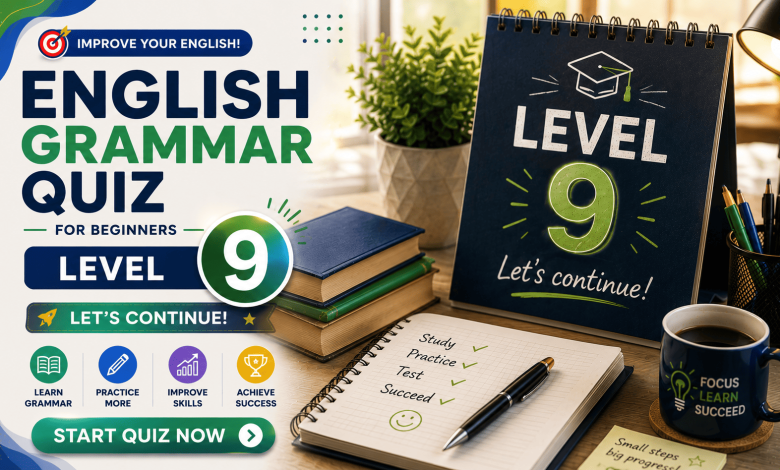
English Grammar Quiz for Beginners – Level 9
Take your English grammar to the next level with advanced lessons, practical examples, grammar tables, useful tips, and 60 challenging questions designed for advanced English practice.
Welcome to Level 9
Welcome to Level 9 of our English Grammar Quiz series. This level focuses on advanced grammar structures that can help you understand formal English, academic writing, professional communication, and more natural everyday English.
You will practice advanced passive structures, reporting verbs, unreal time, advanced present forms, contrasting ideas, noun modifiers, phrasal verb word order, cleft sentences, inverted conditionals, and advanced modal verbs.
Read each lesson carefully before taking the English grammar test. The tables, examples, grammar notes, and common mistakes are designed to make difficult structures easier to understand.
Start With the Lesson
Before taking this advanced English grammar quiz, review the ten topics below. Study the structures, compare the examples, and pay attention to the common mistakes.
Advanced Passive Voice – Reporting & Complex Structures
At advanced levels, the passive voice is not limited to simple forms such as “is made” or “was built”. English also uses passive reporting structures and more complex passive constructions.
| Structure | Example |
|---|---|
| is believed to | He is believed to be very successful. |
| is expected to | The company is expected to grow. |
| is thought to have | She is thought to have left early. |
| has been reported | The problem has been reported several times. |
🧠 Passive Reporting
→ He is believed to be very talented.
The passive reporting structure allows us to focus on the person or thing being discussed rather than the people who have the opinion.
⏳ Earlier Actions
→ She is thought to have left the country.
Reporting Verbs – Advanced Patterns
Different reporting verbs require different grammatical patterns. Learning these patterns helps you report information accurately and naturally.
| Verb | Pattern | Example |
|---|---|---|
| advise | verb + object + to | She advised me to wait. |
| suggest | verb + -ing / that clause | He suggested leaving early. |
| deny | verb + -ing | He denied taking the money. |
| admit | verb + -ing | She admitted making a mistake. |
| promise | verb + to | He promised to help. |
🗣️ Advise
💡 Suggest
⚠️ Common Mistake
✅ She suggested taking a taxi.
✅ She suggested that I take a taxi.
Unreal Time – Present & Past Situations
English sometimes uses past forms to describe situations that are not really past. These forms create distance from reality and are often used with wishes, preferences, and hypothetical situations.
| Expression | Meaning | Example |
|---|---|---|
| I wish | Unreal present | I wish I knew the answer. |
| If only | Strong wish or regret | If only I had more time. |
| It’s time | Something should happen now | It’s time we left. |
| I’d rather | Preference | I’d rather you stayed. |
⏰ It’s Time
Although “went” looks like a past form, the meaning refers to the present or near future.
🎯 I’d Rather
After “I’d rather” + another subject, English often uses a past form for an unreal or preferred situation.
Advanced Present Simple & Continuous
Advanced English uses the present simple and present continuous in more ways than basic habits and actions happening now.
| Form | Advanced Use | Example |
|---|---|---|
| Present Simple | Permanent situations | She works for a technology company. |
| Present Simple | Stories and descriptions | He opens the door and sees a strange box. |
| Present Continuous | Temporary situations | She is working from home this week. |
| Present Continuous | Changing situations | The city is becoming more crowded. |
🔄 Changing Situations
📈 Trends
📖 Narrative Present
Advanced Contrasting Ideas – Despite, Whereas, Much As & While
Advanced English uses several structures to contrast ideas. The grammar after each connector is important.
| Connector | Pattern | Example |
|---|---|---|
| despite | noun / -ing | Despite being tired, he continued. |
| whereas | clause | John likes tea, whereas Mary likes coffee. |
| while | clause | While I understand your point, I disagree. |
| much as | clause | Much as I like him, I disagree with him. |
⚖️ Much As
“Much as” means something similar to “although” and is especially common in formal or advanced English.
🔍 Whereas
✅ Despite being tired, he continued working.
✅ Although he was tired, he continued working.
Possession & Noun Modifiers
English can express possession and relationships between nouns in several ways. Choosing the correct structure makes writing clearer and more natural.
| Structure | Example |
|---|---|
| John’s car | This is John’s car. |
| the roof of the house | The roof of the house is damaged. |
| company policy | You must follow company policy. |
| children’s books | She writes children’s books. |
👤 People
🏢 Noun Modifiers
a school bus
a language course
In noun modifier structures, the first noun describes the type or purpose of the second noun.
🔎 Compare
the school’s bus = the bus belonging to the school
Phrasal Verb Word Order
Phrasal verbs can be separable or inseparable. Understanding word order is essential when the object is a noun or pronoun.
| Type | Example |
|---|---|
| Separable | Turn off the light. |
| Separable with pronoun | Turn it off. |
| Inseparable | Look after the child. |
| Inseparable with pronoun | Look after him. |
💡 Separable Phrasal Verbs
Turn the television off.
Turn it off.
When the object is a pronoun such as it, him, her, or them, it normally goes between the verb and particle in separable phrasal verbs.
🔒 Inseparable Phrasal Verbs
I look after him.
✅ I look after him.
Cleft Sentences – Adding Emphasis
Cleft sentences divide information into two parts to emphasize a particular element. They are useful when you want to make one part of a sentence especially important.
| Structure | Example |
|---|---|
| It was + emphasis + who/that | It was John who called me. |
| It was + time + that | It was yesterday that we met. |
| What + clause + be | What I need is more time. |
🎯 It-Cleft
→ It was you who invited me to the meeting.
The emphasis is on “you”, not another person.
🧠 What-Cleft
→ What I need is more time.
→ What I like most about the course is the practical practice.
Inverted Conditionals – Should, Were & Had
Advanced English can form conditional sentences without using “if”. This structure is more formal and is common in professional and written English. :contentReference[oaicite:1]{index=1}
| Conditional | Inverted Form | Example |
|---|---|---|
| First | Should + subject | Should you need help, call me. |
| Second | Were + subject | Were I you, I would wait. |
| Third | Had + subject | Had I known, I would have helped. |
🟢 First Conditional
→ Should you need any help, please contact us.
🟡 Second Conditional
→ Were I you, I would accept the offer.
🔴 Third Conditional
→ Had I known, I would have helped.
Advanced Modal Verbs – Deduction in the Past
Modal verbs can be combined with perfect forms to make deductions about past events. The choice of modal shows how certain the speaker is.
| Structure | Meaning | Example |
|---|---|---|
| must have + past participle | Strong belief | She must have forgotten. |
| may have + past participle | Possible past event | He may have missed the bus. |
| might have + past participle | Possible but uncertain | They might have gone home. |
| can’t have + past participle | Strong belief something was impossible | He can’t have seen us. |
🟢 Strong Deduction
🟡 Possibility
🔴 Impossible
Quick Grammar Review
Test Your English Grammar
Now test your understanding of the advanced grammar lessons with 60 carefully selected multiple-choice questions. Read every sentence carefully and choose the best answer.
English Grammar Quiz
Test your advanced grammar skills with 60 questions.
Quiz Complete!
Master English Grammar
10 levels • 600 questions • One complete journey
Want to Improve Your English Even Faster?
You’ve completed the vocabulary challenge! 🎉 Now take your English to the next level with more useful words, sentences, expressions, audio and quizzes.
🗣️ Learn 300 English Sentences for Fluency → 📚 Master 3000 Essential English Words → 💬 Learn the 1000 Words You Need to Speak Confidently → 🔥 Discover These Daily English Expressions → ☀️ Learn 100 Daily Sentences & Speak With Confidence →🎯 Choose one lesson and keep practicing every day!